20 October 2004

If Le Carré Could Vote - L. A. Times today

If Le Carré Could Vote from The Los Angeles Times today
COMMENTARY

By John le Carré, John le Carré is the author of The Spy Who Came In From the Cold, Tinker, Tailor, Soldier, Spy and many other novels.


Maybe there's one good reason — just one — for reelecting George W. Bush, and that's to force him to live with the consequences of his appalling actions and answer for his own lies, rather than wish the job on a Democrat who would then get blamed for his predecessor's follies.

Probably no American president in history has been so universally hated abroad as Bush: for his bullying unilateralism, his dismissal of international treaties, his reckless indifference to the aspirations of other nations and cultures, his contempt for institutions of world government, and above all for misusing the cause of anti-terrorism in order to unleash an illegal war — and now anarchy — upon a country that like too many others around the world was suffering under a hideous dictatorship but had no hand in the events of 9/11, no weapons of mass destruction and no record of terrorism except as an ally of the United States in a dirty war against Iran.

Is your president a great war leader because he allowed himself to be manipulated by a handful of deluded ideologues? Is Tony Blair, my prime minister, a great war leader because he committed Britain's troops, foreign policy and domestic security to the same harebrained adventure?

You are voting in November. We will vote next year. Yet the outcome in both countries will in large part depend on the same question: How long can the lies last now that the truth has finally been told? The Iraq war was planned long before 9/11. Osama bin Laden provided the excuse. Iraq paid the price. American kids paid the price. British kids paid the price. Our politicians lied to us.

While Bush was waging his father's war at your expense, he was also ruining your country. He made your rich richer and your poor and unemployed more numerous. He robbed your war veterans of their due and reduced your children's access to education. And he deprived more Americans than ever before of healthcare.

Now he's busy cooking the books, burying deficits and calling in contingency funds to fight a war that his advisors promised him he could light and put out like a candle.

Meanwhile, your Patriot Act has swept aside constitutional and civil liberties that took brave Americans 200 years to secure and were once the envy of a world that now looks on in horror, not just at Guantanamo and Abu Ghraib but at what you are doing to yourselves.

But please don't feel isolated from the Europe you twice saved. Give us back the America we loved, and your friends will be waiting for you. Here in Britain, for as long as we have Tony Blair singing the same lies as George W. Bush, your nightmares will be ours.


catarrh - Word for the Day

catarrh · k&-'tär · noun

: inflammation of a mucous membrane; especially : one chronically affecting the human nose and air passages
- catarrhal -&l · adjective
: of catarrh
: (of a sound) rasping, guttural
- catarrhally · adverb

Etymology: Middle French or Late Latin; Middle French catarrhe, from Late Latin catarrhus, from Greek katarrhous, from katarrhein to flow down, from kata- + rhein to flow cf. stream

19 October 2004

News from the Votemaster

It's a dangerous addiction, the daily electoral vote tally website, www.electoral-vote.com. It's up and down, back and forth. Here's today's comment from the webmaster, showing Kerry 284; Bush 247, and only Iowa an actual tie (although several states, including Florida, are statistical ties):

Kerry keeps moving up in the electoral college. A new Survey USA poll shows he has now inched ahead of Bush in Florida, although his 1% lead means the state is still a statistical tie. Nevertheless, we now show Kerry with more than the critical 270 votes in the electoral college to win. Perhaps more signficant, though, is the fact that in states where Kerry's lead is at least 5%, he has 228 electoral votes. In states where Bush's lead is at least 5%, he has 183 electoral votes. Clearly the race is still wide open.

If you love horror stories, Slate has a good one for you by Richard L. Hasen. In it, he describes five ways the presidential election could end up in the Supreme Court. Briefly summarized, they are:

- Voting glitches involving electronic or other voting machines

- Litigation over which provisional ballots are valid

- A fight over the Colorado amendment to split the electoral vote

- A tie in the electoral college or a faithless elector

- A terrorist attack that disrupts voting in a swing state

Are the voters stupid? It is not considered politically correct to point out that an awful lot of voters don't have a clue what they are talking about. A recent poll from Middle Tennessee State University sheds some light on the subject. For example, when asked which candidate wants to roll back the tax cuts for people making over $200,000 a year, a quarter thought it was Bush and a quarter didn't know. And it goes downhill from there. When asked which candidate supports specific positions on various issues, the results were no better than chance. While this poll was in Tennessee, I strongly suspect a similar poll in other states would get similar results. I find it dismaying that many people will vote for Bush because they want to tax the rich (which he opposes) or vote for Kerry because they want school vouchers for religious schools (which he opposes).


Green: Karl Rove in a Corner

Please read Josh Greens "Karl Rove in a Corner" from the Atlantic, which is available online, unlike most of the magazine.

Suskind: Without a Doubt

Please read Ron Suskind's excellent article "Without a Doubt" from Sunday's NY Times.

cloister - Word for the Day

cloister · 'kloi-st&r · noun

1 a) : a monastic establishment b) : an area within a monastery or convent to which the religious are normally restricted c) : monastic life d) : a place or state of seclusion

2 : a covered passage on the side of a court usually having one side walled and the other an open arcade or colonnade

Etymology: Middle English cloistre, from Old French, from Medieval Latin claustrum, from Latin: 'bar,' 'bolt;' from claudere to close – compare close

18 October 2004

Of Local Interest: Finally, rain, and no fire season

Of Local Interest: The Lost Angeles Area is experiencing its first rain in six months. We got lucky this year, unlike last year, and there was no significant brush fire season.

The U. S. Forest Service recently took the rather drastic, not to say entirely unprecedented, step of closing the Angeles National Forest to virtually all public use in the nearby mountains. If we are to take at face value the stated claim that the only reason for this was the extreme fire danger, there will be no excuse for not lifting this restriction at once now that the rainy season has officially begun.

Safire's non-existent scandal: Mary Cheney

This is William Safire's rather vapid column about the supposed scandal of mentioning Mary Cheney's sexual orientation in the debates.

This was my e-mail to Safire, which I doubt he will ever read:


Mr. Safire,

I do not believe you have any evidence that there was premeditation to the subject of Mary Cheney's lesbianism. Quite frankly, your references to it are insulting to gays and lesbians and disingenuous. Even if there were a "rehearsal" of mention of Mary Cheney, the real "low blows" in this campaign ... the constant cavalier twisting and distortion of Kerry's and Edwards's statements by Bush and Rove's minions, and the outrageous misrepresentations of Kerry's military service perpetuated by barely deniable Bush campaign allies, are so much worse that the idea that this is a scandal is frankly ludicrous. If that's the best you can come up with, I think Kerry and Edwards have nothing to fear from the Right Wing scandal mongers like you.


demise - Word for the Day

demise · dih-'mAIz · verb
Inflected Form(s): demised; demising
transitive senses
1 : to convey (as an estate) by will or lease
2 obsolete : to convey, to give (in general)
3 : to transmit by succession or inheritance
intransitive senses
1 : to die; decease
2 : to pass by descent or bequest [the property has demised to the king]
adjective demised
: (legal) of that which is conveyed, as by a lease
noun
1 : the conveyance of an estate
2 : transfer of the sovereignty to a successor
3 a) : death; b) : a cessation of existence or activity; c) : a loss of position or status
Etymology: Middle French, feminine of demis, past participle of demettre to dismiss, from Latin demittere to send down, from de- + mittere to send; cf. dismiss, remiss, missa, mass.

16 October 2004

Remember the Alamo, Bush's intransigence

From Remember the Alamo -- How George W. Bush reinvented himself by Nicholas Lemann, in the New Yorker, 10/18/04


The long period of preparation for the war in Iraq now appears to have been devoted more to justifying a foregone conclusion than to actually preparing—except in the case of the invasion itself. The Administration’s hawks relentlessly pushed for higher intelligence estimates of the threat that Saddam Hussein represented and for lower military estimates of what the invasion and the occupation would require. Haass, who was frozen out by the hawks, said, “There were a lot of loaded assumptions about the analysis: The aftermath would be a lesser included case of the war. The Iraqis would see the coalition as liberators and they’d be welcomed. Those who didn’t buy in were excluded. People who raised implementation questions were seen as backdoor critics of the war.”

When Bush went to the United Nations in the fall of 2002 and obtained a resolution that got weapons inspectors back into Iraq, it was more as a concession to Powell than as a thought-through Administration policy. The hawks, who had always been contemptuous of the U.N., were dismissive of the inspection process. (A little-noticed nugget in Woodward’s “Plan of Attack” is that the Administration spied on Hans Blix, the chief U.N. weapons inspector, while he was doing his work.) The Administration was unable or unwilling to get the heads of state of the other Security Council members to agree at the outset on what they would consider an unacceptable result from the inspections. So on the eve of war, when Bush declared the result unacceptable, the nations that were capable of sending large numbers of troops to Iraq didn’t agree with him and refused to help, which is one reason that the occupation of Iraq has been so expensive and has stretched the U.S. military past its limits. The Administration consistently pushed every aspect of Iraq policy —intelligence-gathering, diplomacy, military strategy, foreign-policy doctrine, and, of course, the treatment of prisoners—into a new realm of statecraft, characterized by a total and, it has turned out, excessive faith that pure force would produce far better results than anyone had previously realized. Bush’s advisers urged him in this direction, but he chose which advisers to hire and to listen to. It was really a natural outgrowth of who he is.

In the current Presidential campaign, Bush has expertly drawn attention away from how high a price the United States has paid for the war in Iraq. It is difficult to find anybody in Washington, in either party, who will seriously defend Bush’s management of Iraq. Most of the available armed forces of the United States are pinned down in a place that represents a threat chiefly because American troops are there. That limits American options in places that pose much more genuine threats. The reputation of American intelligence agencies has been badly damaged—would anyone now heed warnings from them? It is increasingly difficult to imagine other major powers joining the United States in an international endeavor, even one that isn’t a war. The government’s financial resources are depleted. The U.S. military in Iraq has started trying to take back areas of the country now controlled by insurgents, and it may not be safe enough there for the scheduled elections to be held in January. The country still has no meaningful army or police force. It doesn’t seem that there will be, any time soon, a way to extract the American forces without risking Iraq’s descent into chaos, of a kind that would be both dangerous and humiliating to the United States and would betray Bush’s repeated promises to bring the Iraqis a better life.

15 October 2004

Post: E. J. Dionne: Bush's tired tactics

From E. J. Dionne's very good article in today's Post about Bush's tired campaign tactics:

...Bush showed that he cared far more about caricaturing Kerry's plan than solving the problems of the uninsured. Inventing out of whole cloth a scheme that has nothing to do with what Kerry is proposing, Bush noted that the federal employee plan "costs the government $7,700 per family." Then he took a leap into the mathematics of political distortion. "If every family in America signed up, like the senator suggested," Bush said, "it would cost us $5 trillion over 10 years."

Pardon the word, but that's a lie, because Kerry has "suggested" no such thing. As Kerry quickly noted, families that could afford to buy into the federal plan under his proposal would have to pay for it. "We're not giving this away for nothing," Kerry said in one of his most effective counterpunches.


affray - Word for the Day, Friday, 15 October 2004

affray · uh-FREI · noun

:a tumultuous assault or quarrel; a brawl.
_______________________________________________________
Mounted encounters by armored knights locked in desperate hand-to-hand combat, stabbing and wrestling in tavern brawls, deceits and brutalities in street affrays, balletic homicide on the dueling field--these were the martial arts of Renaissance Europe.
--Sydney Anglo, The Martial Arts of Renaissance Europe

An Irish soldier was stabbed with a boar spear by a German mercenary in 1544 during an affray that followed Henry VIII's capture of Boulogne.
--James Williams, "Hunting, hawking and the early Tudor gentleman," History Today, August 2003
_________________________________________________________

Affray comes from Old French esfrei, from esfreer, "to disquiet, to frighten."


14 October 2004

Clemons: Kerry wins decisively on women's issues

See Steven C. Clemons's article for UPI on the third debate.

esplanade · Word for the Day, Thursday 14 October 2004

esplanade · 'es-pl&-"nahd, "es-pl&-' also -'nEId or -"nEId · noun
: a level open stretch of paved or grassy ground; especially : one designed for walking or driving along a shore
Etymology: Middle French, from Italian spianata, from spianare to level, from Latin explanare, also source of explain

13 October 2004

Last Debate / No spin reaction

I just finished watching the entire debate from Tempe on television, and turned it off immediately so as not to hear any of the instant spin from television commentators telling us what we should think.

My reaction, in general:

Bush was well-schooled in "handling" himself, and acquitted himself creditably in that regard. But, when it came to substantive answers to many of the questions, he really had little or nothing to say. His campaign, especially recently, has been all about pandering to people's fears of an uncertain world. When it came to any solid record of domestic accomplishment or plans to solve America's problems, Bush had little or nothing to offer on almost every front.

Kerry was vague about some of his plans (inevitably in a debate format), but was nonetheless far more coherent in his responses than Bush. His message of connection with the needs and primarily economic concerns of the majority of Americans was communicated much more effectively than Bush was capable of.

In all, I think it was a win for Kerry, and to the extent that it was viewed by a reasonable fraction of the television audience, it should help him to edge ahead in the next three weeks.

Link to Petition to Sinclair Broadcasting

Between October 21 and 24, Sinclair Broadcast Group will force the local television stations it owns and operates to preempt regular network broadcasts and devote one hour to an anti-John Kerry "documentary," actually a piece of Bush campaign propaganda masquerading as "public affairs." Please link below to a petition to SBG registering your protest against this usurpation of public trust.

Sign this petition and try to stop this madness.


Arianna Huffington: Appealing to the Lizard Brain: Why Bush is Still Standing

A friend sent me this, originally from Arianna Huffington's website.


It's neuroscience, stupid!

APPEALING TO OUR LIZARD BRAINS: WHY BUSH IS STILL STANDING
By Arianna Huffington


Since the president's meltdown in the first debate — followed in quick succession by Paul Bremer's confession, the CIA's no-al-Qaida/Saddam link report, the Duelfer no-WMD-since-'91 report, and the woeful September job numbers — I have been racking my brain trying to figure out why George W. Bush is still standing.


The answer arrived via my friend Ed Solomon, the brilliant writer and filmmaker, who explained that the conundrum could be solved by looking at the very organ I'd been racking.


Ed introduced me to the work of Dr. Daniel Siegel, a Harvard-trained psychiatrist and author of the forthcoming book "Mindsight," which explores the physiological workings of the brain.

Turns out, when it comes to Campaign 2004, it's the neuroscience, stupid!
Or, as Dr. Siegel told me: "Voters are shrouded in a 'fog of fear' that is impacting the way our brains respond to the two candidates."

Thanks to the Bush campaign's unremitting fear-mongering, millions of voters are reacting not with their linear and logical left brain but with their lizard brain and their more emotional right brain.

What's more, people in a fog of fear are more likely to respond to someone whose primary means of communication is in the nonverbal realm, neither logical nor language-based. (Sound like any presidential candidate you know?)
And that's why Bush is still standing. It's not about left wing vs. right wing; it's about left brain vs. right brain.

Deep in the brain lies the amygdala, an almond-sized region that generates fear. When this fear state is activated, the amygdala springs into action. Before you are even consciously aware that you are afraid, your lizard brain responds by clicking into survival mode. No time to assess the situation, no time to look at the facts, just: fight, flight or freeze.

And, boy, have the Bushies been giving our collective amygdala a workout. Especially Dick Cheney, who has proven himself an unmatched master of the dark art of fear-mongering. For an object lesson in how to get those lizard brains leaping, look no further than the vice-presidential debate.

"The biggest threat we face today," said Cheney in his very first answer "is the possibility of terrorists smuggling a nuclear weapon or a biological agent into one of our own cities and threatening the lives of hundreds of thousands of Americans."

Just in case we didn't get the point, he repeated the ominous assertion, practically word for word, two more times — throwing in the fact that he was "absolutely convinced" that the threat "is very real." It was "be afraid, be very afraid" to the third power.

And when we are afraid, we are biologically programmed to pay less attention to left-brain signals — indeed, our logical mind actually shuts itself down. Fear paralyzes our reasoning and literally makes it impossible to think straight. Instead, we search for emotional, nonverbal cues from others that will make us feel safe and secure.

When our right brain is at Threat Level Red, we don't want to hear about a four-point plan to win the peace, or a list of damning statistics, or even a compelling, well-reasoned argument that the policies of Bush and Cheney are actually making us less safe. We want to get the feeling that everything is going to be all right.


In this state, our brains care more about tone of voice than what the voice is saying. This is why Bush can verbally stumble and sputter and make little or no sense and still leave voters feeling that he is the candidate best able to protect them. Our brains are primed to receive the kinds of communication he has to offer and discard the kinds John Kerry has to offer, even if Kerry makes more "logical sense." Which, of course, he does.

The strutting, winking, pointing and near-shouting that marked Bush's town hall debate performance all sent the same subconscious message to our fear-fogged brains: "I'm your daddy . . . I've got your back. So just go to sleep and stop thinking. About anything."

"At the deepest level," Dr. Siegel told me, "we react to fear as adults in much the same way we did as infants. It's primal. Human babies have the most dependent infancy of any species. Our survival depends on the caregiver. We instinctively look to authority figures to comfort us and keep us safe."

As needy infants, this natural drive to be soothed and reassured is what we looked for in our parents; as anxious adults in these exceptionally unsettling times, it's what we are looking for in our leaders.

Over the remaining three weeks of the campaign, as the anxiety level reaches a fevered pitch — and you can be certain the Bush campaign will do everything in its power to make sure that happens — the test facing voters is no longer, "Which candidate would you rather have a beer with?" It's "Which candidate would you rather give you your blankie and a bottle and keep the boogeyman away?"

I know it sounds ludicrous that the most important election of our lifetime is coming down to who can best pacify the electorate's inner baby, but I can think of no better explanation as to why Bush is not currently hovering at around 5 percent in the polls — a voting block made up of those hardcore fanatics who are as utterly blind to reality as he is.

As long as we're operating from our lizard brains — and reason takes a back seat to more primal needs — George Bush will continue to survive the logic-based attacks on his ever-escalating failures.

The only question that remains is: Can Bush, Cheney and Rove keep us shrouded in the fog of fear long enough to brain John Kerry and win in November?


Contact Sinclair's National Advertisers

If you want to let Sinclair Broadcast Group's national advertisers know you object to their use of the public airwaves to disseminate Right Wing propaganda as if it were public affairs programming (see story below), here is a list, with links to contact information, of Sinclair national advertisers. Let them know, politely but firmly, that you want their help in defending principles of fairness and democracy on the airwaves!

Premonstratensian - Word for the Day, Wednesday 13 October 2004

Premonstratensian · "prE-"män(t)-str&-'ten(t)-sh&n · noun
: a member of an order of monastic canons regular founded by Saint Norbert at Prémontré near Laon, France, in 1120; aka Norbertine
--adj.
: of or relating to same
Etymology: Medieval Latin praemonstratensis, from praemonstratensis, 'of Prémontré,' from Praemonstratus, L. for Prémontré (lit. something like “Mountain Fields”).

12 October 2004

A fact-checked Bush resumé

The following George Bush resumé was sent to me. It was compiled by a 2000 Bush supporter who now questions how anyone can support this president's re-election. Here is the original intro, with links:

The Resume of George W. Bush

A few weeks ago a family member sent me an email titled "John Kerry's Resume". It misrepresented Kerry on more than a few points and the mean-spirited tone seemed to get in the way of serious arguments but it got me wondering what a Bush resume would look like. I found a few "George W. Bush's Resume" versions online but they were filled with the same sort of distortions and inaccuracies, and seemed written for an audience of people who already dislike Bush and support Kerry. It annoys me when people who share my view make their case so poorly that it undermines our position. I thought I could do better.

As I wrote this I started realizing the problem with our current president. Rewarding excellence and limiting failure is a deeply held value in America, especially in conservative circles. It is essential that we recognize the competence of juniors and promote them. By promoting our smartest, most efficient, highest-skilled workers to positions of responsibility we don't just reward them: we reward ourselves as we benefit from the good decisions they make in their new position.

Bush is the antithesis of this story. From Yale to the Champagne Unit to Harvard to Arbusto to Spectrum 7 to Harken to Texas Rangers to Governor to President, his failure was rewarded with ever-greater responsibility as the sphere of those damaged by his incompetence continued to expand. And that's how we got where we are today: the entire world is paying the piper because nobody had the guts to pull the brakes on this man's train of unearned, undeserved privilege.

My target audience is Bush supporters for whom their choice of candidate is still a rational decision. As a former Bush supporter in 2000 I don't see how anyone can support this president's run for a second term. Even if you believe his goals are sound, his ability to achieve those goals and the means he chooses to achieve them remain highly questionable. I have avoided points such as drilling in ANWR or Bush's enthusiastic execution record as governor of Texas because I don't fault him for those reasons: points such as those have reasonable positions on either side. I'm sticking to points like exposing the secret identity of CIA agents as revenge for their spouses' public statements, or creating an agency to re-inject discredited intelligence reports back into circulation - points that, to me, seem beyond any rational defense.

It is quite likely that this is not the final version of this document. I consider myself a rational person, and I'm expecting to revise the document as new information becomes available. While I don't have time to get into extended one-on-one political arguments with strangers I welcome the sort of input and rational criticism that will clarify my misconceptions. I expect to add new points and remove weaker ones throughout Bush's remaining term: I've found his resume to be a useful crib sheet to remember details like the name of Bush's personal criminal defense attorney, or the vote tally for the Federal Marriage Amendment, and I'd like it to remain "live".

There are two versions of my version of the Bush Resume online: one for reading online and one for printing. Their formatting is different but they are otherwise identical. I hope you find this useful in making your choice for president this year.

http://monkeydyne.com/bushresume/resume.html

http://monkeydyne.com/bushresume/print.html

http://monkeydyne.com/bushresume/errata.html


Hello. My name is George Bush and I'm running for President. Please consider my qualifications as set forth in the following resume.

The Resume of George W. Bush


EDUCATION:

CRIMINAL RECORD:
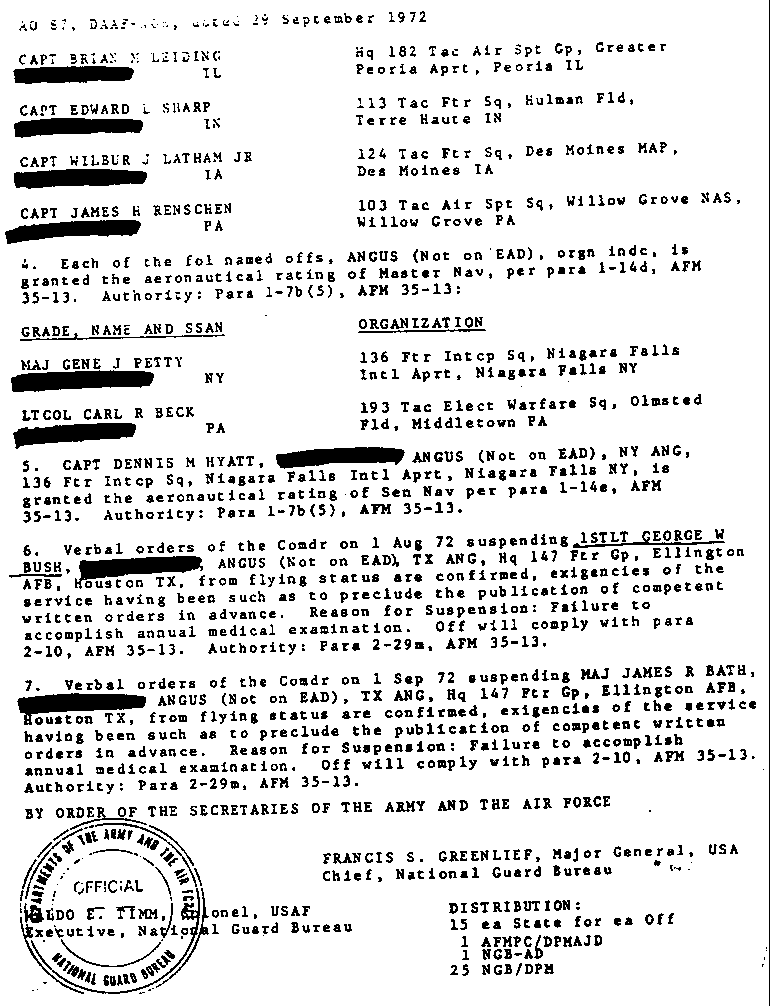
MILITARY EXPERIENCE:


PROFESSIONAL EXPERIENCE:

POLITICAL RECORD (DOMESTIC)
POLITICAL EXPERIENCE (FOREIGN)

donnybrook - Word for the Day, Tuesday 12 October 2004

donnybrook · 'dä-nE-"brük · noun
1 : free-for-all, brawl
2 : a usually public quarrel or dispute

Usage: often capitalized
Etymology: Donnybrook Fair, annual Irish event known for its brawls

11 October 2004

Right Wing Broadcaster to force propaganda film to air

On the announced intention by Sinclair Broadcast Group, a publicly-traded company with direct control over the programming of 62 TV stations around the country, to order its TV outlets to run an anti-Kerry piece of propaganda on the public’s television airwaves in the days leading up to the election, I directed the comment below to their website's comment link. Anyone wishing to add 2 cents to this argument may wish to post an e-mail to the same link.

As
The Leftcoaster reports:

The conservative-leaning Sinclair Broadcast Group ... is ordering its 62 TV stations to air a film that attacks Sen. John F. Kerry's activism against the Vietnam War, network and station executives familiar with the plan said Friday.

Sinclair has told its stations — many of them in political swing states such as Ohio and Florida — to air "Stolen Honor: Wounds That Never Heal," sources said. The film, funded by Pennsylvania veterans and produced by a veteran and former Washington Times reporter, features former POWs accusing Kerry — a decorated Navy veteran turned war protester — of worsening their ordeal by prolonging the war. Sinclair will preempt regular prime-time programming from the networks to show the film, which may be classified as news programming, according to TV executives familiar with the plan.

My e-mail:

To Sinclair Broadcast Group:

I am writing to object to the planned forced broadcast of "Stolen Honor: Wounds That Never Heal."

It is highly inappropriate, and indeed, very probably actionable as grounds for revocation of licenses for failure to comply with the public interest mandates of the Communications Act of 1933 and its subsequent regulatory implementation, for SBGI to order its stations to air this film. It is clear that this film is not news or public affairs, but propaganda intended to influence the outcome of the presidential election.

It is not any individual decision to air the film, but the use of the monopoly power of the organization to compel its brodcast by member stations, which I believe to be in violation of both the spirit and the letter of the law.

I hope you will reconsider this very ill-advised move. It shows disrespect for the diversity of opinion in this nation, and reflects a desire to use the public trust of license to operate broadcast stations on the publicly-owned airwaves in a mannner entirely inconsistent with the required dedication to service to the public, which applies to all of the public, not only the supporters of the current administration.


Thank you.
David Studhalter


Kerry electoral vote West Coast + Northeast/Midwest

The current projected electoral vote is more than ever geographically lopsided, with the Northeast and Midwest all Kerry or tied (Except for Indiana and Missouri), along with the West Coast (including Nevada). This comes to 280, a winning margin. The rest of the country is Bush.

Dirty Tricks on the way

I repeat this from Josh Marshall's Talkingpointsmemo. He also has an interesting piece on Republican dirty tricks in the 2000 election in New Hampshire.

Karl Rove tells Sean Hannity about 'October Surprise' he's working on. "We've got a couple of surprises that we intend to spring," says Rove
.

ping - Word for the Day, Monday 11 October 2004

ping · 'pi[ng] · noun

: a sharp, high-pitched sound such as that of a striking bullet on metal

- transitive verb [Telecommunications]

: to send a signal along a circuit for purposes of testing connectivity

- intransitive verb

: to make a pinging sound

Etymology: imitative

Ping · geographical name


:river, 579 kilometers, originating in W Thailand flowing SSE to join Nan River forming the Chao Phraya

08 October 2004

Unspun take on debate

I have refrained from reading a lot of spin span spun stuff about tonight's debate. Anyone who knows me or who's read much of this site already knows I'm a leftish Democrat, so obviously Kerry's positions were much more palatable to me.

On the question of debating effectiveness, I think you have to acknowledge that Bush did quite a bit better in this appearance than in the first one. He had his usual swaggery personality and simplistic, nattering slogans, but his "base" loves that shit, and probably ate it all up. I'm sure the GOP bloggers are saying he wiped the floor with Kerry.

Kerry was articulate, clear, and presidential. Any thoughtful person, who cares anything at all about the dignity of the office, would have to prefer the more serious, thougthful, analytical style and substance of Kerry's presentation, irrespective of the actual views expressed.

I hope that more undecided voters, not already enamored of Bush's phoney folksiness, will be more impressed with Kerry's clear command of the issues and obviously more thought-out plan for actually governing the country.

All in all, it was not as clear a win for Kerry as the first debate, but I think Bush only managed to help himself with his base of support, whereas Kerry may have furthered, if only a little, his momentum with swing voters.

Bush wired during first debate?

Salon.com features a photo of what is rumored to have been a receiver for a secret earpiece, giving Bush prompts during the first debate. Personally, I'm a bit skeptical.

Manchester Union Leader: John Eisenhower endorses Kerry

A colleague sent me this:

Why I Will Vote for John Kerry for President
By John Eisenhower
The Manchester Union Leader
Tuesday 28 September 2004


The Presidential election to be held this coming Nov. 2 will be one of extraordinary importance to the future of our nation. The outcome will determine whether this country will continue on the same path it has followed for the last 3* years or whether it will return to a set of core domestic and foreign policy values that have been at the heart of what has made this country great.


Now more than ever, we voters will have to make cool judgments, unencumbered by habits of the past. Experts tell us that we tend to vote as our parents did or as we "always have." We remained loyal to party labels.

We cannot afford that luxury in the election of 2004. There are times when we must break with the past, and I believe this is one of them. As son of a Republican President, Dwight D. Eisenhower, it is automatically expected by many that I am a Republican.

For 50 years, through the election of 2000, I was. With the current administration's decision to invade Iraq unilaterally, however, I changed my voter registration to independent, and barring some utterly unforeseen development, I intend to vote for the Democratic Presidential candidate, Sen. John Kerry.

The fact is that today's "Republican" Party is one with which I am totally unfamiliar. To me, the word"Republican" has always been synonymous with the word "responsibility," which has meant limiting our governmental obligations to those we can afford in human and financial terms. Today's whopping budget deficit of some $440 billion does not meet that criterion.


Responsibility used to be observed in foreign affairs. That has meant respect for others. America, though recognized as the leader of the community of nations, has always acted as a part of it, not as a maverick separate from that community and at times insulting towards it. Leadership involves setting a direction and building consensus, not viewing other countries as practically devoid of significance. Recent developments indicate that the current Republican Party leadership has confused confident leadership with hubris and arrogance.

In the Middle East crisis of 1991, President George H.W. Bush marshaled world opinion through the United Nations before employing military force to free Kuwait from Saddam Hussein. Through negotiation he arranged for the action to be financed by all the industrialized nations, not just the United States. When Kuwait had been freed, President George H. W. Bush stayed within the United Nations mandate, aware of the dangers of occupying an entire nation.

Today many people are rightly concerned about our precious individual freedoms, our privacy, the basis of our democracy. Of course we must fight terrorism, but have we irresponsibly gone overboard in doing so? I wonder. In 1960, President Eisenhower told the Republican convention, "If ever we put any other value above (our) liberty, and above principle, we shall lose both." I would appreciate hearing such warnings from the Republican Party of today.

The Republican Party I used to know placed heavy emphasis on fiscal responsibility, which included balancing the budget whenever the state of the economy allowed it to do so. The Eisenhower administration accomplished
that difficult task three times during its eight years in office. It did not attain that remarkable achievement by cutting taxes for the rich. Republicans disliked taxes, of course, but the party accepted them as a necessary means of keep the nation's financial structure sound.

The Republicans used to be deeply concerned for the middle class and small business. Today's Republican leadership, while not solely accountable for the loss of American jobs, encourages it with its tax code and heads us in the direction of a society of very rich and very poor.

Sen. Kerry, in whom I am willing to place my trust, has demonstrated that he is courageous, sober, competent, and concerned with fighting the dangers associated with the widening socio-economic gap in this country.

I will vote for him enthusiastically.

I celebrate, along with other Americans, the diversity of opinion in this country. But let it be based on careful thought. I urge everyone, Republicans and Democrats alike, to avoid voting for a ticket merely because it carries the label of the party of one's parents or of our own ingrained habits.

John Eisenhower, son of President Dwight D. Eisenhower, served on the White House staff between October 1958 and the end of the Eisenhower administration. From 1961 to 1964 he assisted his father in writing "The White House Years," his Presidential memoirs. He served as American ambassador to Belgium between 1969 and 1971. He is the author of nine books, largely on military subjects.


Horserace, Kerry momentum

The MSNBC "horserace map" shows 121 tossup votes, with Bush and Kerry roughly at partity otherwise. Tossups once again include Ohio, PA, Michigan, and Florida. I'd say Kerry MUST build momentum in the next two weeks, and if he does, he has a solid chance of winning.

See also electoral-vote.com, which once again (for the first time in weeks) shows Kerry winning.

07 October 2004

Copse - Word for the Day, Thursday, 7 October, 2004

copse · KOPS · noun

:a thicket or grove of small trees.

A lit window shone from between the trees below them, then vanished again as the car dipped over a ditch and passed through a copse.
--Kate Bingham,
Mummy's Legs

Among the mountains, hills, streams, waterfalls, and little
copses, the child rejoiced in "savouring the delights of
freedom" that stimulated his boyish dreams and reveries.
--Suheil Bushrui and Joe Jenkins,
Kahlil Gibran: Man and
Poet

They sang freely in the copses and thickets round Bohain,
and in the ruins of the mediaeval castle where he played as
a boy.
--Hilary Spurling,
The Unknown Matisse

_________________________________________________________

Copse derives from Old French copeiz, "a thicket for cutting," from coper, couper, "to cut." It is related to coupon, at root "the part that is cut off."


06 October 2004

Cheney not Satan

Noam Scheiber's article in The New Republic* starts out with this:

There were two key factors at work in the vice-presidential debate last night. The first was expectations. Going into the debate, both candidates probably had low expectations working in their favor--John Edwards because of his reputation as a lightweight, Dick Cheney because of his reputation for being Satan. But Cheney's expectations were far easier to exceed. All he had to do was come off as, well, not Satan, and he'd do wonders for his public image.

*Unfortunately, subscription only.

sere - Word for the Day, Wednesday, 6 October 2004

sere, also sear · SiiR · adjective

:dry; withered.

. . . a country that has been transformed from a place of
lush abundance to a sere, mutilated, inhospitable land.
--Zofia Smardz, "A Nice Place for Extinction," New York
Times
, June 15, 1997

Recent rains have done little to relieve the sere
conditions.
--Thomas Omestad, "The struggle over water," U.S. News
and World Report
, April 10, 2000

Mr. Campbell, a biologist, spent three seasons in the
Antarctic and returned with eerily clear perceptions of
that sere and uninhabitable place.
--Review of The Crystal Desert, by David G. Campbell; New
York Times
, December 5, 1993

There was a lavatory at the end of the garden beyond a
scraggy clump of Michaelmas daisies that never looked well
in themselves, always sere, never blooming, the perennial
ghosts of themselves, as if ill-nourished by an exhausted
soil.
--Angela Carter, Shaking a Leg

_________________________________________________________
Sere comes from Old English sear, "dry."

05 October 2004

Edwards winner

The consensus seems already to be that Edwards scored an advantage for the Democratic campaign. He remained on message and made appeals to what matters to most people, whereas Cheney stuck to a message of fear and tried to play games with numbers to make Edwards seem like a liar, and it just didn't work. Cheney looked tired and, although he is obviously quicker and better able to match wits than W., he failed to advance the desired impression of "strength."

Some impressions:

Cheney was unconvincing in making the case that Iraq is "progressing." Edwards's point that the war is being badly managed came across relatively well.

Cheney had no real answers for Edwards's domestic points; just to deny that the Bush administration is cutting programs and failing to create jobs or do anything about declining health coverage and real wages.

I think people are tired of being told that they should vote on the basis of fear. They want to hear what will be done for them, not that they "better vote for us, or bad things might happen." Cheney seemed testy, and even a little bit disengaged, which creates a quite negative impression.

At worst, this debate will not help Bush and will not hurt Kerry.

George Soros: We must not re-elect Bush

Please see George Soros's speech on why we must not re-elect Bush.

What if the whole world could vote in the U.S. Election?

A colleague sent me this obviously unscientific polling site, that asks this question. Nonetheless...

Not only European countries (where Kerry's 9 to 1 preference has been reported before), but almost all countries seem to prefer Kerry by a large margin. Notice the overall figures: Kerry: 87%, Bush: 12%.

Surely this should tell us something about America's standing in the World. Only the most craven troglodytes care nothing that we are more hated than ever before.

I notice that the Færoe Islands prefer Dubya
2 to 1. Maybe we could offer him to them (... it's a little cold there). I'd go along with an appropriation to pay his moving costs.

machicolation - Word for the Day, Tuesday 5 October 2004

machicolation · m&-"chi-k&-'lEI-sh&n · noun

1 a : an opening between the corbels of a projecting parapet or in the floor of a gallery or roof of a portal for discharging missiles upon assailants below – compare battlement
b : a gallery or parapet containing such openings

2 : construction imitating medieval machicolation-


machicolated · m&-'chi-k&-"lEI-t&d · adjective

Etymology: Medieval Latin machicolare to furnish with machicolations, from Middle French machicoller, from machicoleis machicolation, from macher to crush + col neck, from Latin collum – compare collar

02 October 2004

See Bush Debate. See Him Squirm.

From "Not So Neutral Corner" by Ciro Scotti in Business Week.

He looked like a hapless teen called on the carpet as Kerry channeled Poppy and termed the Iraq invasion a "colossal error"

Watching George W. Bush on the hot seat is painful. When he gets that fawn-in-the-deerjacker's-light look, you feel for the guy.

Publicly at least, he's not a mean-spirited man. Near the end of Thursday's debate when he was asked if he had any reservations about John Kerry's character, he was gracious, momentarily generous, and generated the evening's only human moment. And not just because his opponent is a fellow Skull & Bones man (see BW Online, 10/1/04, "Republicrat vs. Democan"). That's usually the way Bush comes across -- a likable Joe, sincere in his beliefs, and comfortable in his own skin.


DEBATING POPPY. Besides that, he's the President and has led the nation at a time of enormous peril and uncertainty (some of it, arguably, of his own making). Love him or detest him, he sits at the desk where the buck makes its last stop.

But in Coral Gables, Fla., last night, Bush looked -- at least for the first half of the debate -- like Elmer Befuddled, a commander-in-chief not in command.

Perhaps what was so unnerving was that Bush found himself in a foreign-policy debate with a seasoned politician who was espousing the same sort of measured, internationalist approach to a dangerous world that was the hallmark of his father's Presidency. Debating the security and future of the nation on live national television isn't easy -- but debating your Dad is downright scary.

FACING THE MUSIC. Of course, the differences between Kerry and George H.W. Bush are legion. But there's that War Hero Thing. That Air-of-the-Patrician Thing. That Tall-and-Gangly Thing. That Awkwardness-with-Other-People Thing. And Kerry in his embarrassing windsurfing togs was reminiscent of Poppy Bush in his geeky skydiving suit.

Kerry even brought up Bush the elder when he said the President's father did not continue into Iraq after driving Saddam Hussein from Kuwait in the Persian Gulf War because he knew "there was no exit strategy" and feared that American soldiers would face a hostile populace (see BW Online, 10/1/04, "Kerry Lands the First Punch").

When Kerry, methodically making his case like the prosecutor he once was, said, "This President has made a colossal error of judgment" by invading Iraq, Bush looked like a 1960s teenager called on the carpet for cracking up the family Oldsmobile. At that moment, it was hard not to get the impression that young George wanted to be anyplace but where he found himself.

SPUTTERING SCREWUP. The poignancy of a man ill-prepared for and overwhelmed by his job was never more apparent than when Bush said, "I never wanted to commit troops. When we were debating in 2000, I never dreamed I'd have to do that."

The message that Kerry hammered home was that, in fact, Bush did not have to "do that," did not have to send our soldiers -- at least not to Iraq.

But Bush, the onetime black sheep of his family, wanted to wipe away the "wimp factor" stain that his old man had left on the Bush clan. And so he rebelled against the family mantra of prudence in all things. Last night, he looked for all the world like a sputtering screwup -- again.

Wolcott: Tweet Smell of Success

I love this... an excerpt from Tweet Smell of Success on James Wolcott's website. (Wolcott is author of Attack Poodles and Other Media Mutants : The Looting of the News in a Time of Terror).

Only a few weeks ago, things looked grim. Bleak. Even posters on the liberal blogsites seemed to be sitting on the suicide ledge peering past the slough of despond into the abyss below. That infamous Gallup Poll which had the race Bush 104, Kerry -6 had many of us rattled. A statistically impossible 110 point deficit seemed a mite difficult to overcome.

But that was before John Kerry grape-stomped Bush into a sullen mash.

In birding, those fanatical about building up the life lists of species are known as "twitchers." But there was no bigger twitcher last night than the bird-hating Bush, who once ignorantly shot a killdeer during a photo op thinking it was a dove, according to Karen Hughes' merde-eating memoir. Bush's face suffered a silent outbreak of Tourette's Syndrome; he grimaced, smirked, sniffed, rolled his eyes, and did some weird thing with his mouth that as yet has no diagnostic name. He was President Twitchy, giving a performance that critics hailed as "peevish" and "petulant."

We've seen President Twitchy before. When Helen Thomas persisted in asking Bush why he was trying to tear down the walls between church and state, and wouldn't be sluffed off with one of his standard nonanswers, Bush, as I wrote in Attack Poodles, went through a battery of irked expressions that ended with him imitating Tony Perkins in the final shot of Psycho, looking as if he had a fly on his nose.

Since then Bush has been wheeled out into forums where no one can dare question or contradict his majesty, where he can lean forward and repeat ad nauseam his patented soundbites. Last night I believe we saw the ugly comeback of the private face of Bush--the irritable expressions he flashes subordinates when he's presented with information he doesn't like or feels someone's taken up too much of his time or is pressed to explain himself to people he shouldn't have to explain himself to because he's the president and fuck you. The notion that Bush is "likeable" has always been laughable. It takes a Washington pundit to be that dumb. He's an angry, spoiled, resentful little big man--I use "little big man" in the Reichian sense of a small personality who puffs himself up to look big through bluster and swagger but remains a scheming coward inside--and next to a genuinely big man like Kerry, shrunk before the camera's eyes.

01 October 2004

Extent of Right Wing Nonsense

I came across a link on a bulletin board to this inane little observation on one of the Bushies' BBSs.

Of Bush, Kerry, and Bush's NecktieMy fevered brow 10-01-2004 By Laz
Posted on 10/01/2004 11:59:30 AM PDT by
Lazamataz
I noticed something last night.
G.W. Bush's necktie was askew. It looked unprofessional. I wondered HOW in the heck that could have happened.
Then during the replay, I saw how it happened. When Kerry greeted Bush, Kerry held on to Bush's hand as Bush was walking away. Bush was forced to awkwardly stretch his torso, dislodging the correct placement of the tie.
I initially thought it was all happenstance. But on further review, I saw that Kerry made a point of adjusting his tie after the handshake, just in case the manuever dislodged his too.
Maybe it was an accident, maybe not. I think not. If anyone has contacts to Bush, please advise them of this possible purposeful action, or at the very least, MAKE SURE BUSH'S TIE IS STRAIGHT. I was focused on the tie, it looked so sloppy.

Fox News Fabricates Kerry Quotes

In one of the weirder post-"debate" whirligigs, Josh Marshall's Talkingpointsmemo reports that Fox News completely fabricated deprecatory quotes attributed to Kerry... and got caught red-handed doing it.

CBS News: Uncommitteds Say Kerry "won" debate

Look at CBS News' polling of supposedly uncommitted voters' reactions to the "debate. "

piebald - Word for the Day, October 1

piebald · 'pAI-"bahld · adjective


1 : of different colors; especially : spotted or blotched with black and white
2 : composed of incongruous parts

“Silhouetted against rolling, stormy, clouds, the piebald horse stands, turning its head slightly to suggest its alertness to its surroundings.”

Decisive Win for Kerry

People always tend to see their preffered guy in a favorable light, but it seemed very clear to me that Kerry was decisive, coherent, intelligent, substantive, gracious, and sober; while the Prez was testy, repetitive, simplistic, and far more inclined to make conclusory statements rather than offer thought-out reasons for his positions.

I think this was a solid win for Kerry, and I just hope enough people were watching, and listening with an open mind, to change the direction of this election.

The whole thing was pretty much devoid of humor, despite Bush's snide and infantile sniggering here and there. This reflects, no doubt, on the seriousness of this election. Thus, the gravitas shown by Kerry, in contrast to the impression of contempt and arrogance displayed by Bush, should work to Kerry's advantage.